
Words create reality
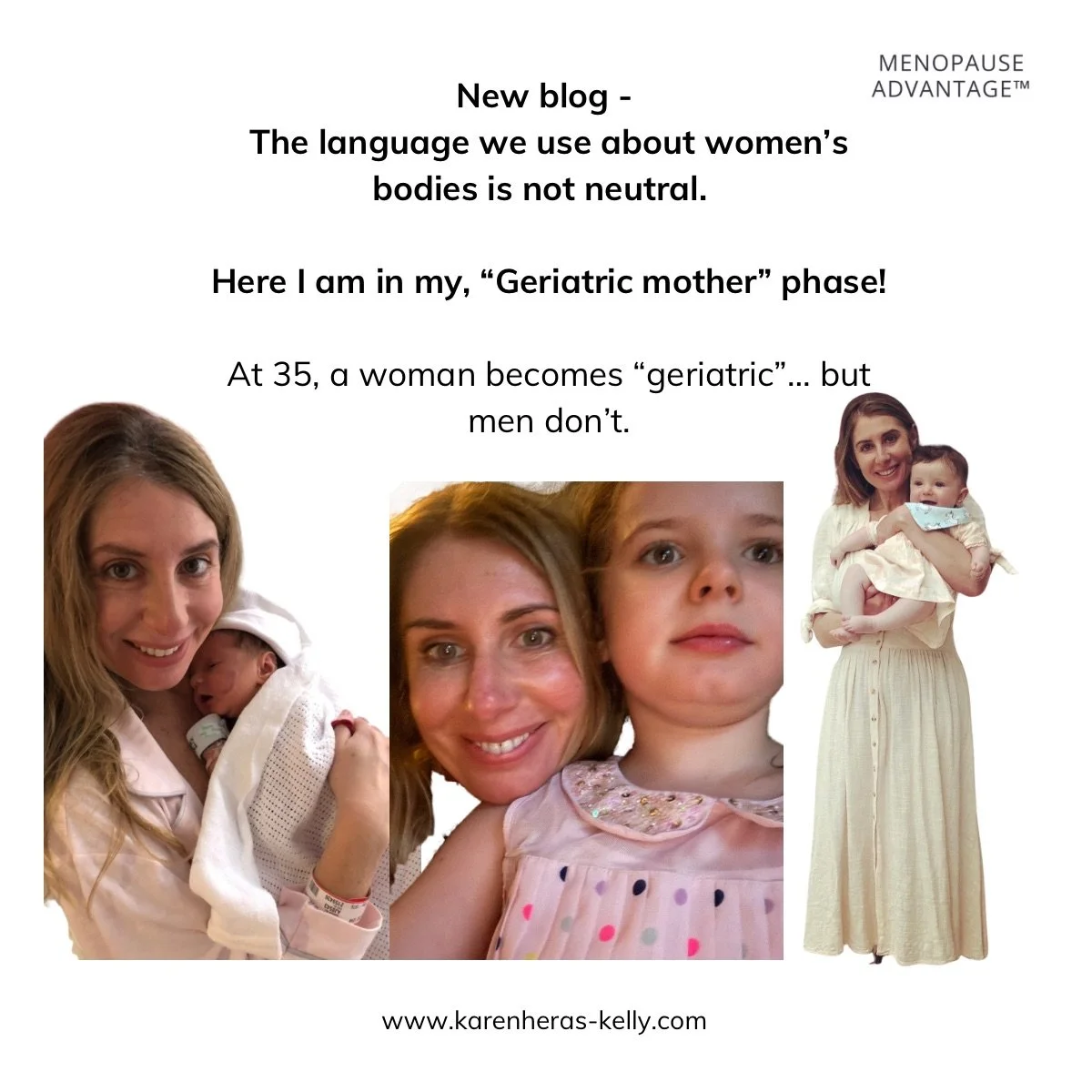
Becoming a Mum really opened my eyes to the language used to describe women’s bodies.
I’ve had a lifetime of being told my body was “too much” and “not enough.” That I was both too young and too old for my experiences.
My first period came at nine. From then on, painful periods were “just part of being a woman” or so I was led to believe. I always felt my hormones were out of balance, but there was no language for that beyond “you’re sensitive” or “it’s normal”.
At 35, I felt a clear shift in my energy.
At 40, I was diagnosed with an underactive thyroid.
At 41, a routine operation revealed a fibroid and endometriosis that had been silently shaping my pain and fatigue for years.
Only in my 40s did I properly learn about my menstrual cycle: when I ovulated, how my energy rose and fell through the month, how my body moved in seasons. It was empowering and infuriating. Why had no one taught me this sooner?
At 42, I became pregnant. I was labelled a “geriatric mother.” I miscarried. I developed PTSD.

After my daughter was born, I experienced postpartum perimenopause. By 46, I was on a HRT journey and told I was “young to be on HRT”, even as my body screamed otherwise.
At 50, I still experience severe pain. And I have lost count of the times my symptoms were minimised and my questions left unanswered.
The language we use about women’s bodies is not neutral.
It shapes diagnosis. It shapes treatment. It shapes how women see themselves and far they are willing to push.
And too often, that language is rooted in outdated, male-centred models of health and power.
When a woman’s pain is repeatedly minimised, she starts to doubt her own experience.
That’s not just bad communication; it’s a form of gaslighting with clinical consequences.
“Normal for your age.”
Translation: we’re not going to look deeper.
“Normal for your age” is often code for “we don’t have time, resources, or curiosity to explore this properly”.
I heard variations of this for decades: painful periods, fatigue, brain fog, mood swings. All “normal”. All real. All under-investigated.
Often women’s complex transitions are minimised into irrelevance.
Menopause is a major hormonal, neurological, and identity shift. The current approach erases the scale of what’s happening – and the support women need.
Starting HRT at 46, I was told I was “young” to need it, even as my body was clearly in perimenopause. The message was clear: your experience doesn’t fit our script, so we’ll adjust the story, not the system.
We need better language and a different approach.
We need language that:
• Describes the physiology, not the perceived failure.
• Centres the woman’s experience, not the system’s convenience.
• Makes space for complexity, instead of collapsing it into “just anxiety” or “just menopause”.
We also need women who can name what’s happening – in their bodies, their careers, their lives – without being labelled “too much”.
That’s why I do this work: to help women reclaim their narratives, their confidence, and their power. To build workplaces where women’s experiences are supported because they are too valuable to loose.
This is why my Menopause Advantage™ work matters.
When the language around women’s bodies is steeped in bias, menopause becomes another label to silence us: “just menopause”, “too old”, “declining.”
But menopause is not a decline. It’s a transition of power.
It’s the point where many of us stop apologising for our pain, our needs, and our truth. Menopause Advantage is both symptom support and reclaiming the narrative.
It’s about turning the “too much” woman into the woman who knows her worth, speaks her reality, and leads from lived experience. We need a culture that recognises menopause as a strategic, creative, and leadership advantage – for women, and for the organisations smart enough to listen.