

I can’t help but wonder: if menopause were treated as a rite of passage, an honour, a source of wisdom and power, would we be experiencing menopause in the same way?
The question I’m now asking myself is this - is this menopause, or is it patriarchy?
Is the way women are being treated, controlled and squeezed into moulds not made for them a key factor in how this transition feels?
Because not every culture treats women in midlife as past it. Not every culture fixates on anti-ageing and a woman’s outward image. Hello Victoria Secrets recent catwalk show…
In Japan, the midlife transition is called kōnenki - understood as a broader season of change, not simply “the end of menstruation”.
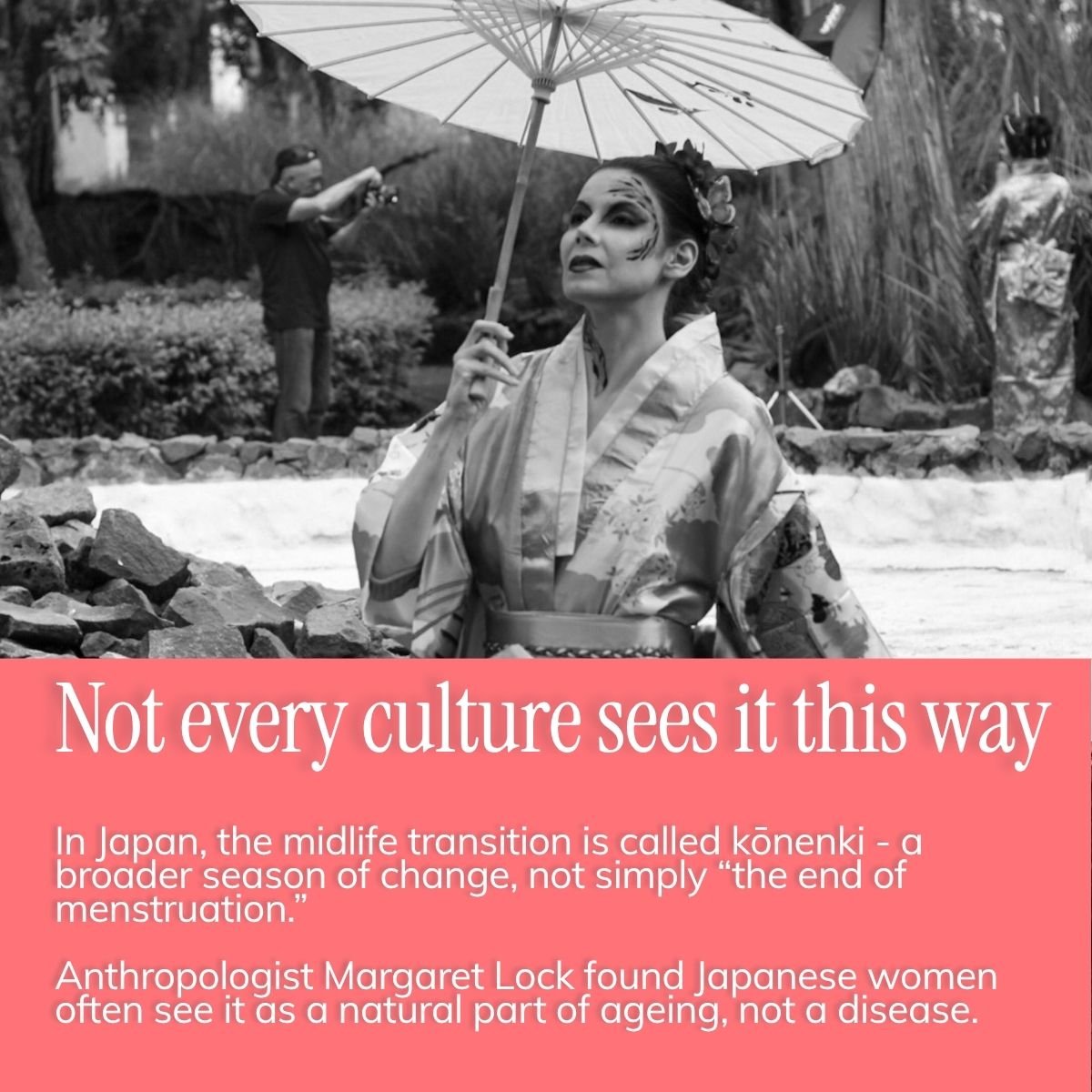
Anthropologist Margaret Lock’s research found Japanese women attach relatively little importance to the end of their periods, seeing it as a natural part of ageing - not a disease.
In rural Haryana, India, researchers found women welcomed menopause for the social status and freedom it brought. And in Mayan communities in Mexico and Guatemala, women have described looking forward to menopause - to the new freedom and standing that come with it, some becoming spiritual leaders in their villages.
A woman is either too young or too old, never just right. And in archetypal patriarchal systems, women are possessions. We see command and control. We see coercive behaviours around money, sex and power.
My work includes men in menopause conversations. Why? Well the patriarchy hurts men too - it trades their emotional lives for a script of stoicism and providing, then leaves them alone with the cost.
A system that polices women’s worth, bodies and experiences and men’s feelings & worth in the same breath was never built for human beings.
The symptoms are real, and women deserve proper care. I’m questioning the stigma, not the biology. But how much harder does a culture of control and anti-ageing make this transition?
Personally, I’ve had the wool pulled off my eyes - and now I see the roadblocks, and how they’re impacting women of all ages.
If menopause were treated as a rite of passage, an honour, a source of wisdom and power - would we still experience it as loss?
The claims, and their sources:
• Kōnenki as a broader midlife transition, with Japanese women attaching little importance to the end of menstruation and seeing it as natural rather than disease-like, comes from Margaret Lock’s anthropological study Encounters with Aging.
• The Haryana finding: women welcomed menopause for increased social status, freedom from managing menstruation and a “transition to a normal life” - is from a study by Vanita Singh and M. Sivakami, reported by 360info.
• Mayan women looking forward to menopause for freedom and status, and taking on roles as spiritual leaders, is documented by Women’s Health Network, which also notes the reasons for their symptom differences remain unclear - so the caption keeps that claim modest.[womenshealthnetwork]
